How WordPress agencies add retainer capacity without hiring another developer
Retainer growth stalls when every change burns senior review time. Here is how to buy capacity with a preview-and-approve loop instead of another headcount.
Agency growth stories usually sound the same: win more retainers, hire another WordPress developer, hope margin survives onboarding.
That math breaks when the bottleneck is not "we need more hands typing in Elementor." The bottleneck is review time — the senior person who has to make sure a small request does not take the homepage down.
If you cannot increase capacity without adding that person, you do not have a staffing problem. You have a workflow problem.
What retainers actually sell
Clients are not buying hours. They are buying the ability to change the site safely and quickly:
- Swap seasonal offers without a two-week wait
- Fix mobile layout issues before a campaign launches
- Publish landing pages without a custom build ticket
- Trust that "quick edits" will not create a restore drama
When your delivery model is "open a ticket, wait for a developer, hope staging matches production," you are selling delay. Competitors with a faster, safer loop will take the retainer — even if their design quality is average.
The capacity trap
Take an agency with 20 WordPress retainers and a thin web team. Demand is fine. Throughput is not.
A typical change request still costs 45–90 minutes of senior attention when production is the only place work becomes real. Ten of those a week is a hire you cannot quite justify and cannot quite avoid. Friday deploys become culture. Margin disappears into invisible cleanup.
Hiring helps until the new person also needs review. Then you have two people waiting on the same scarce approval capacity.
Buy capacity with a review loop
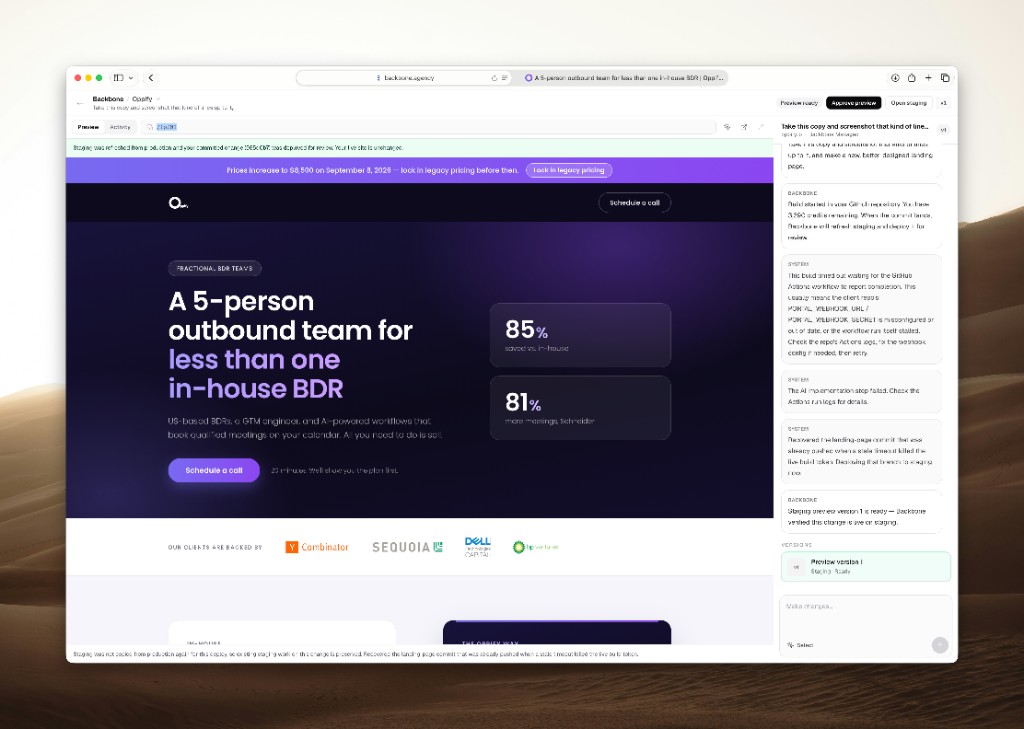
Agencies that scale retainers treat every change like a pull request for the website:
- The client (or AM) describes the outcome in plain language.
- A preview is built against a real copy of the live site.
- Someone accountable reviews the plan and the preview.
- Nothing publishes until approval.
- Rollback is a first-class action, not a ticket.
That loop changes the economics. A junior teammate can review a preview in ten minutes. Clients can see the change before it goes live. Seniors stop being the only people allowed to touch production.
You are not removing humans. You are removing unreviewed production edits.
What to measure this quarter
Pick five recurring request types from the last 90 days. For each one, track:
- Minutes of senior time today
- Whether a preview exists before publish
- Whether the client saw the preview
- Whether rollback is possible without a restore
If senior time is high and preview rate is low, hiring will not fix the queue. The queue will just get more expensive.
Where Backbone fits
Backbone is built for that review loop on existing WordPress sites: describe the change, get a safe preview, approve before publish. Agencies use it to keep retainers moving without making every request a custom job.
If the change-request queue is the thing keeping you from taking more sites, start a free agency trial or read how we think about safe AI edits.
Ready to try the review loop on a real site?
Start a free agency trial, or go back to the blog index.